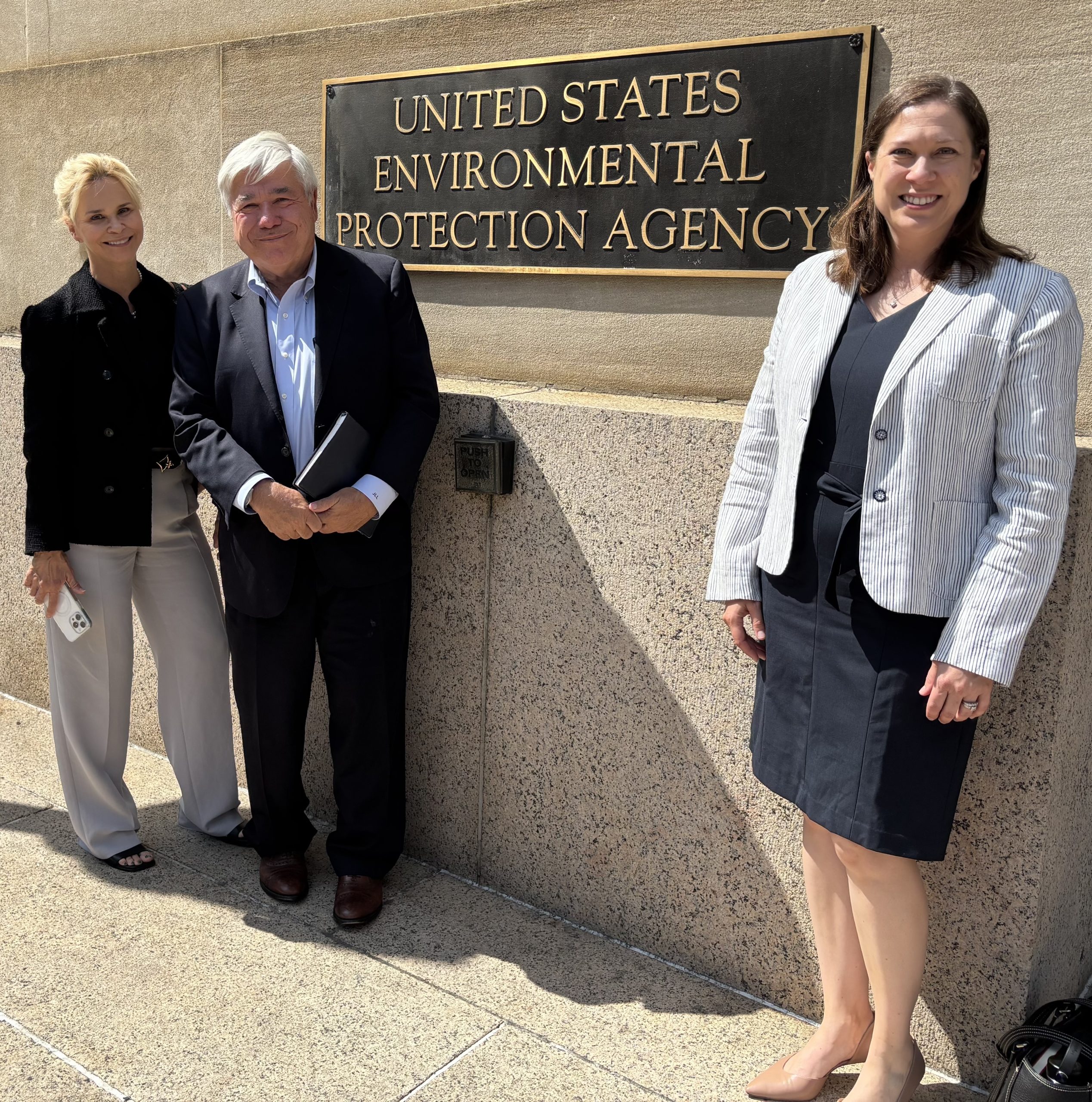
On July 28, ILMA staff and counsel met with the U.S. Environmental Protection Agency’s Office of Resource Conservation and Recovery to address the agency’s concerns over the management of used industrial containers and its empty container rule.
The “1-inch rule,” put in place 40 years ago under the Resource Conservation and Recovery Act (RCRA), allows used industrial containers –– such as drums and IBCs –– with no more than 1 inch of residue to be classified as empty and treated as nonhazardous waste when sent to reconditioners. However, a 2022 EPA report raises concerns over the management of these containers, which have resulted in fires and other incidents at reconditioning sites. Read more in the March 2025 issue of Compoundings magazine.
As used container generators, ILMA members could be subject to burdensome new requirements if current rules are changed. ILMA has been active on this issue, submitting comments on an Advance Notice of Proposed Rulemaking published in 2023 and offering again earlier this month to work with the agency on non-regulatory solutions.
In the meeting, ILMA’s General Counsel Jeff Leiter and Regulatory Counsel Jorge Roman emphasized that regulatory change is unnecessary. EPA staff seemed receptive to ILMA’s proposal to collaborate on nonregulatory options to enhance compliance in the lubricants industry. They also agreed with ILMA on the importance of a thriving drum reconditioning industry for meeting sustainability goals.
ILMA will now seek input from members on specific container emptying practices used in their plants, what kinds of checks are in place to ensure containers are RCRA-empty before they are sent to reconditioners, and other relevant information that can inform the development of best practices. Members are encouraged to give their input so ILMA can continue to present a strong case for non-regulatory solutions.
The Association will also engage with other stakeholders such as the Recycled Industrial Packaging Association (RIPA) to explore collaboration.
Update (Sept. 18, 2026): On September 16, a federal court granted a preliminary injunction blocking New Mexico’s PFAS product labeling regulation, which […]
A federal district court has upheld Oregon’s packaging extended producer responsibility (EPR) law against constitutional challenges brought by the National Association of […]
What Happened The 50% tariffs on certain Canadian goods are now in effect, including duties on some lubricant additives imported into the […]
We use cookies to improve your experience on our site. By using our site, you consent to cookies.
Manage your cookie preferences below:
Essential cookies enable basic functions and are necessary for the proper function of the website.
Google Tag Manager simplifies the management of marketing tags on your website without code changes.
These cookies are used for managing login functionality on this website.
WPForms is a user-friendly WordPress plugin for creating custom forms with drag-and-drop functionality.
Statistics cookies collect information anonymously. This information helps us understand how visitors use our website.
Google Analytics is a powerful tool that tracks and analyzes website traffic for informed marketing decisions.
Service URL: policies.google.com (opens in a new window)
You can find more information in our Privacy Policy and .